


Solution · Insider AI-Agent Risk
Your own agents hold the keys. Watch the door.
Coding, ops, team and personal AI agents act with real tokens and no one watching. Solomon holds their critical actions for a human signature, guards the secrets they can reach and blocks exfiltration in the kernel.
- agentclaude-alice · scope interactiveowner alice
- holdkubectl delete ns paymentsinfra.k8s.destructive
- sentDenial ID dn_01J9… to the owner's phonepending
- denyopenat ~/.ssh/id_ed25519EPERM
- denyconnect upload.example.net:443not allowlisted
- grantapproved with Face ID · single usesigned
- allowkubectl delete ns paymentsonce
Illustration of an agent session on a developer workstation with holds enforced.
The insider you hired
Trusted agents, real keys.
The risk is not a rogue employee. It is a helpful agent with a live token that does what a prompt, a bug or an attacker tells it to.
IP exfiltration
- An agent with repository and shell access can send source, models or data anywhere
- Solomon limits each agent's network egress to the destinations you allow
- Model weights, vector stores and system prompts are guarded at the file level
Credential harvesting
- Agents run next to cloud keys, SSH keys, kubeconfigs and other agents' tokens
- Unapproved reads of those files are reported, or refused in the kernel where you enforce
- Decoy credentials trip a high-severity alert the moment anything opens them
Lateral escalation
- A trusted agent can delete a namespace, force-push or change infrastructure
- Those actions are held until the agent's owner approves them on a phone
- Unattended agents are frozen in place while they wait, not left running
Capabilities
DLP and AI security for every agent you run.
Controls in the kernel, decisions on a phone and deterministic rules in between.
Human-in-the-loop (HITL) approvals
- Destructive Kubernetes, Terraform, force-push and sensitive-file actions held for the agent's owner
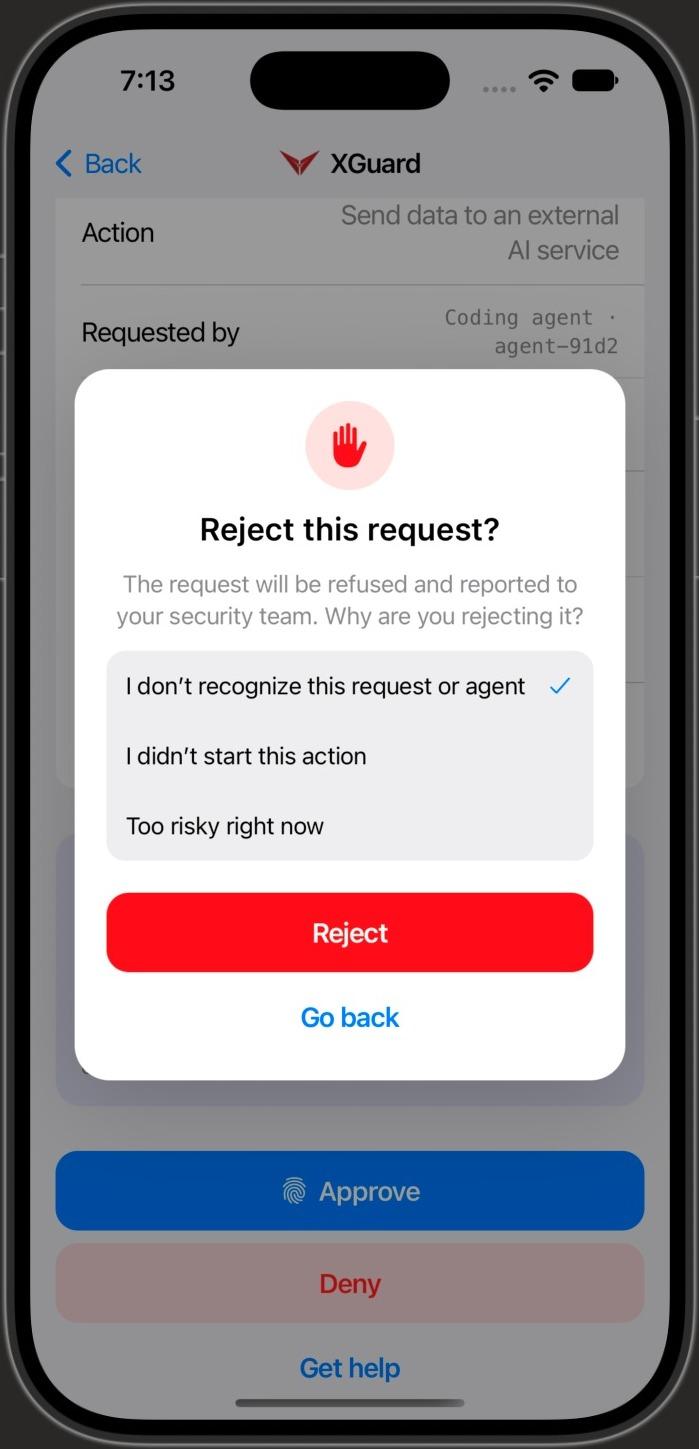
- An approval allows exactly that action, once; anything else is still denied
- Requests expire to deny, and a built-in “Deny and pause agent” stops it outright
Data loss prevention (DLP) for agent actions
- DLP findings, target host and parameters shown before anyone approves
- Egress allowlists per agent or workload scope, by address or domain
- AI assets protected: model weights, vector-store data, prompts and LLM configuration
Secret and token protection
- Covers AI-agent and MCP credentials, GitHub, Kubernetes, Docker, npm and cloud CLI tokens
- Browser cookie and saved-login stores included
- Monitor everywhere, enforce inside the scopes you choose
Agent discovery and scoping
- Recognizes Claude Code, Codex, Gemini CLI, Cursor, Copilot, Aider and more when they start
- Moves each one into its own scope, so its rules follow it and nothing else
- Registered agents are bound to the person who owns them
Honeytoken canaries
- Decoy cloud credentials, SSH keys, kubeconfigs and .env files placed on the host
- No legitimate program reads them, so they are enforced by default
- A read is denied and raised as a high-severity alert
Deterministic guardrails
- Every action an AI agent proposes passes 10,000+ YARA and Sigma rules
- Agent identities never count as approvers, and queued remediation needs a second person
- Every hold, approval and denial is an auditable event
Solomon XGuard · iOS and Android
A human signature on every critical action.
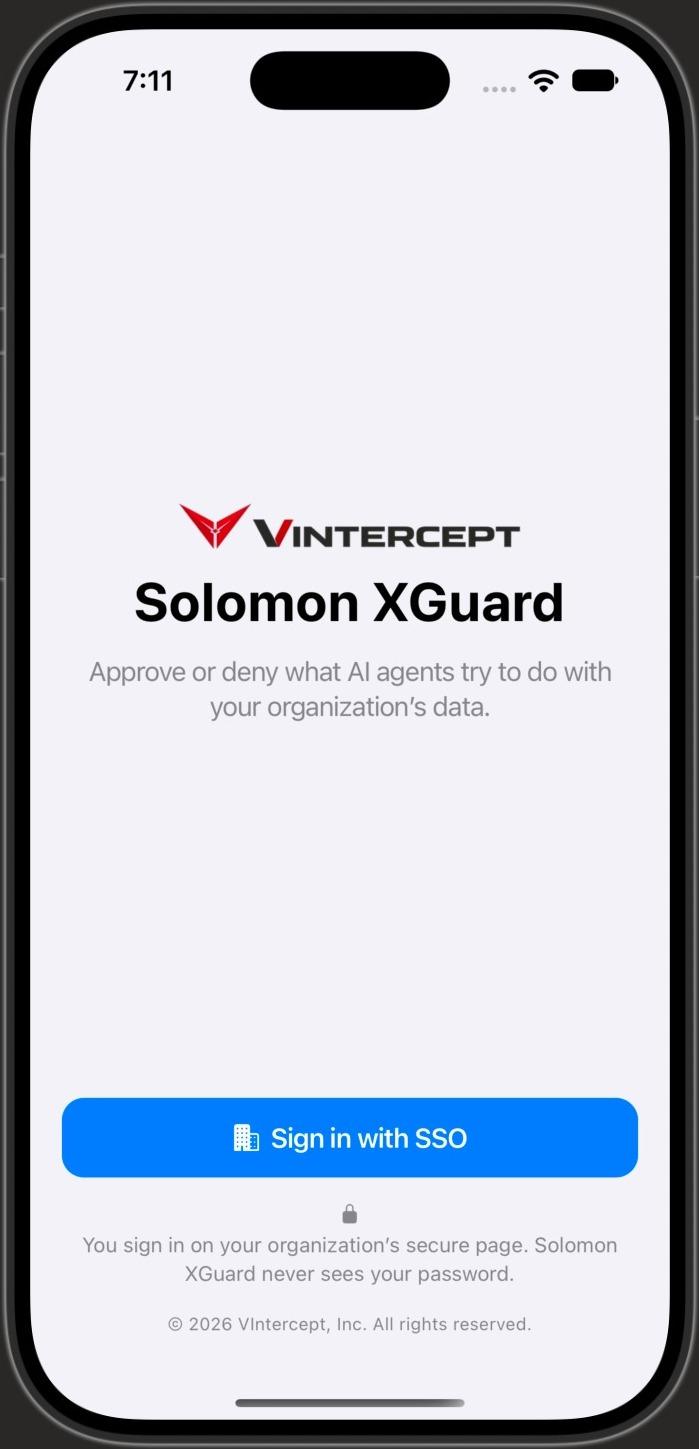
When an agent tries a held action, its owner gets the request on their phone and approves with Face ID or a fingerprint. The signature comes from a key in the phone’s secure hardware; there is no PIN fallback.
- Agent
- who owns it and what framework it is
- Action
- the exact command and its parameters
- Target
- the host it will run on
- DLP
- what the payload contains
- Risk
- a risk tier and a verdict on the agent's justification
Holds ship in monitor mode: you see what would have been held before you turn enforcement on, agent by agent.
Measured and by design
- Every approval1
- single-use grant
- to deny a credential-file read in the kernel2
- 6–34 µs
- Deterministic rules3
- 10,000+
- Containment4
- < 300 µs
- 1Each approval is a non-replayable grant bound to one action, host, time window and human signature.
- 2Emulated AI-agent swarm evidence run, 1 Oct 2026: medians, MITRE ATT&CK T1552.001.
- 3YARA and Sigma rules applied in the Platform's deterministic layer (owner-confirmed, 19 Oct 2026).
- 4Emulated AI-agent swarm evidence run, 1 Oct 2026: credential-file theft denied in 6–34 µs, process-secret dumps in 15–31 µs, attacker process tree killed in 31–130 µs, IMDS theft in 55–200 µs (medians).
Built for developers
Routine work never waits.
A signed catalog decides what is routine and what needs a person. Read-only work runs untouched; only the actions you list wait for an approval.
Hooks for Claude Code, Cursor and Codex ask before a tool runs, and the kernel backs them up for anything a hook cannot see.
- dev.readonly
- never paused
- vcs.git.force_push
- held for approval
- infra.k8s.destructive
- held for approval
- infra.terraform.mutate
- held for approval
- fs.sensitive.write
- held for approval
Solomon platform
Which products
- Human in the loopSolomon XGuardThe owner approves or denies each held action on their phone, with a hardware-signed decision.Explore
- Kernel actsSolomon eBPF ClientScopes each agent, holds its critical actions and blocks secret access and exfiltration in the kernel.Explore
- AI agents thinkSolomon Agentic AI PlatformRoutes approval requests, scores the risk and enforces deterministic rules and four-eyes approval.Explore
Let your agents work. Keep the keys.
Run Solomon on the workstations and servers where your agents live. We’ll show you what they reach today, and what a held action looks like on your phone.